Fast response of paramedics equipped with defibrillators, airway devices, and heart medications gives cardiac arrest victims the best chance of survival. When paramedics arrive quickly and administer life-saving interventions such as CPR, defibrillation, and advanced medical care, they provide cardiac arrest victims with their best chance of survival. These timely interventions stabilize the heart, restore circulation, and support vital organ function, ultimately improving the chances for recovery.
Chain of Survival
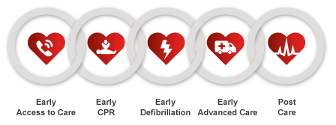
The term “Chain of Survival” provides a useful metaphor to help improve cardiac arrest patients’ chances of survival and recovery. The five critical links in the adult out-of-hospital Chain of Survival, when executed promptly and effectively, dramatically increase the likelihood of survival and recovery. Each link in this chain is interconnected, reinforcing the others to maximize a victim’s chances:
- Recognition of Cardiac Arrest and Notification to the 9-1-1 System:
The first link in the chain is recognizing the signs of cardiac arrest—such as sudden collapse, loss of consciousness, and absence of breathing—and immediately notifying emergency services by calling 9-1-1. Prompt notification ensures that help is on the way as soon as possible. - Early CPR with an Emphasis on Chest Compressions:
The next step is to begin high-quality, hands-only CPR as soon as cardiac arrest is recognized. The emphasis on chest compressions is crucial because it helps circulate oxygen-rich blood to the brain and other vital organs until more advanced care arrives. The quicker CPR is initiated, the greater the chances of maintaining life-sustaining blood flow. - Early Defibrillation – The Delivery of a Shock to the Heart Using an AED:
The third link involves the prompt use of an Automated External Defibrillator (AED) to deliver a shock to the heart if needed. AEDs can restore a normal heart rhythm by delivering an electric shock, which may be the critical action to save a life. Fast access to an AED and defibrillation can greatly improve the chance of survival for someone in cardiac arrest. - Early Advanced Care from Highly Trained Paramedics:
Once paramedics arrive, they provide advanced care, which may include airway management, administering medications, and further defibrillation. Paramedics are trained to stabilize the patient, restore cardiac function, and manage any complications that arise, all while en route to the hospital. Early advanced care is essential for optimizing outcomes in the critical minutes following cardiac arrest. - Advanced Life Support and Post-Cardiac Arrest Care:
The final link in the Chain of Survival involves advanced life support and post-cardiac arrest care provided by hospital teams. After arrival at the hospital, patients receive more specialized care, such as therapeutic hypothermia or further cardiac interventions, to ensure the best possible long-term recovery. This phase focuses on reducing the risk of neurological damage and stabilizing the patient’s condition for the long term.